
The Lost Ring of William Shakespeare
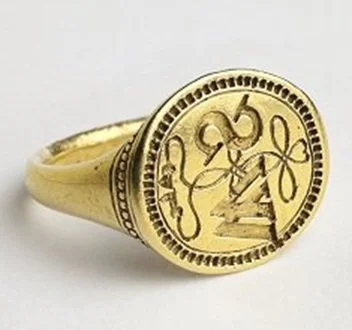
The original Shakespeare ring held by the SBT
On the 16th of March, 1810, Mrs. Martin, a local resident of Stratford-Upon-Avon, made a remarkable discovery. In a field near Holy Trinity Church, she found a heavy signet ring, black with age. Hoping to find that it was valuable, she took it to a local silversmith who cleaned it up. It was a solid 21.5-carat-gold gentleman’s ring with the letters WS on the bezel. The letters are reversed so they appear the right way ‘round when used as a wax seal.
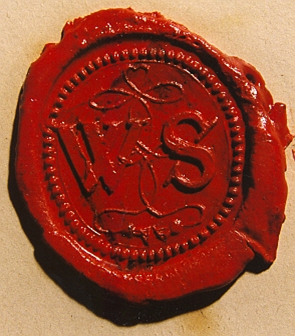
A wax seal formed with the Shakespeare ring
A local historian, Robert Wheler, bought the ring from Mrs. Martin for the value of the gold. She earned the equivalent of two weeks of her husband’s wages. Wheler acquired a literary treasure.
He made a close study of his new acquisition. The style matched similar rings of the late Elizabethan period, and the quality of the ring and value of the gold pointed toward a very wealthy Stratfordian. Could this be William Shakespeare’s ring?
In the months leading up to his death in 1616, Shakespeare penned his last will and testament. At the end of the document, he wrote, “In witnes whereof I have hereunto put my seale” but later crossed out “seale” and inserted “hand,” ultimately signing the document rather than affixing a wax seal. The logical conclusion is that he owned a seal when he first drafted his will but had lost it by the time he signed the final version.
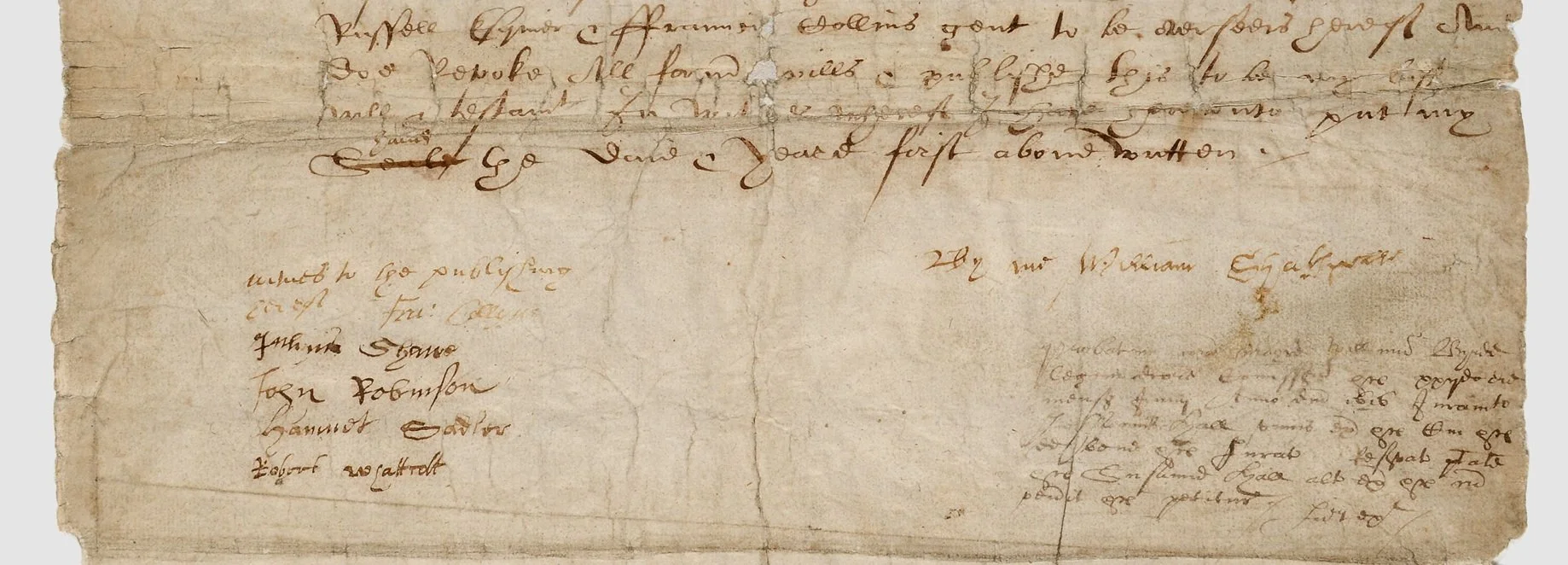
The bottom of the final page of William Shakespeare’s will, with the word “seale” struck through and replaced with “hand.”
The first draft of Shakespeare’s will, including the “seale” language dates to January 1616. He signed the final version with “seale” marked through on 25 March, 1616. His seal went missing sometime in between.
Not—I think—coincidentally, on 10 February, 1616, Shakespeare’s younger daughter Judith got married at Holy Trinity Church in Stratford-Upon-Avon. Scholars posit that this occasion is when his ring slipped off his finger and was lost in the dirt, where Mrs. Martin found it nearly two hundred years later.
Rings don’t generally slide off that easily, but rings of this period had large bands so they could be admired when worn over gloved hands. This particular ring certainly was, given its size.
A cold February day, a pair of new, slick gloves, and the distraction of your child’s wedding: the perfect storm for a ring to slip unnoticed from a finger.
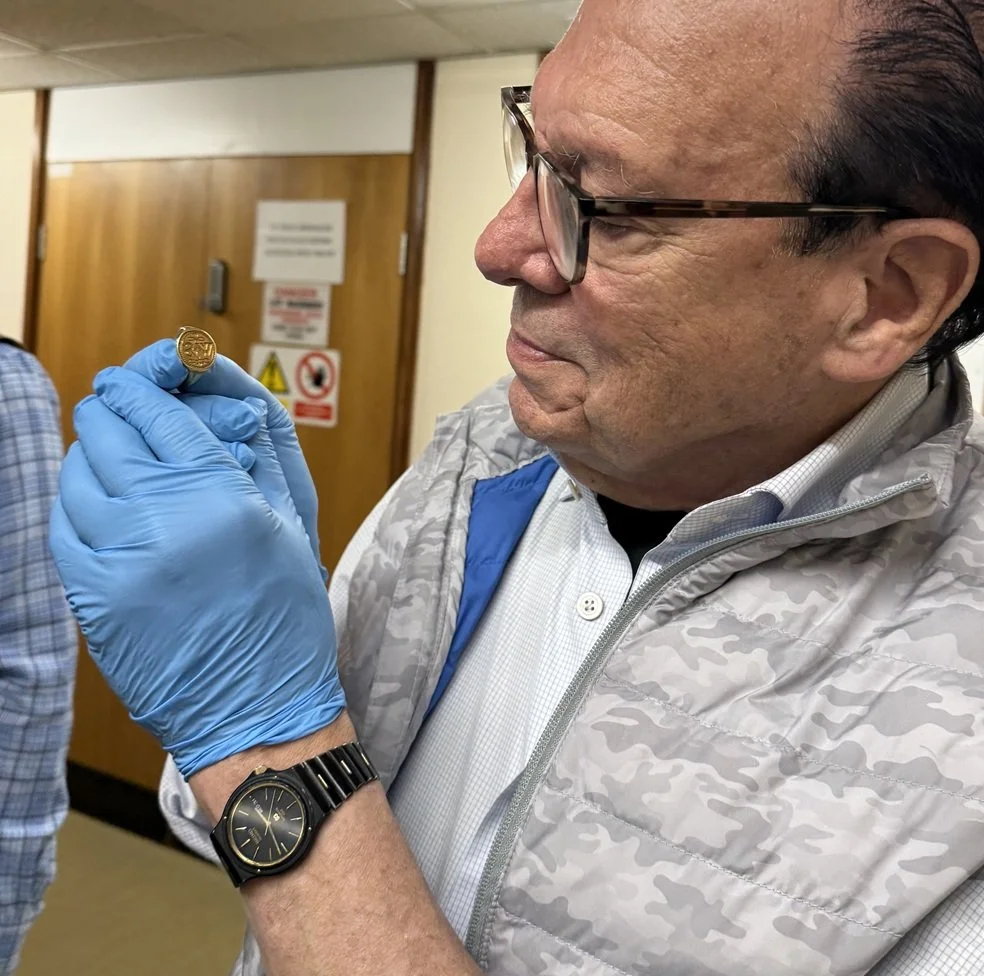
Admiring the original Shakespeare ring in the archives of the Shakespeare Birthplace Trust
Robert Wheler was convinced, as I am, that this is William Shakespeare’s ring. Fortunately for posterity, when Wheler passed away in 1868, his sister donated the ring to the Shakespeare Birthplace Trust, which had been founded 21 years earlier. The SBT has held it as part of the organization’s Special Collections ever since. It was the thrill of a lifetime to visit the archives and handle the ring myself.

I’ve admired various replicas of the Shakespeare ring over the years. Last year, I finally decided to ask my friends at the Shakespeare Birthplace Trust if they could help me have one made by a jeweler who could access, study, and as closely as possible, recreate the original. They very kindly facilitated the work, and I recently met with the jeweler to collect it.
I now wear my Shakespeare ring every day, and it reminds me of the plays that have inspired me since childhood, the wonderful family I’ve gained at the Shakespeare Birthplace Trust, and the pride I have in my ongoing work aiding their mission to preserve and celebrate Shakespeare for the ages.